
![THE HERALD STUDENT REPORTERS [US]](/assets/images/logo_student_us.png)
![THE HERALD STUDENT REPORTERS [Canada]](/assets/images/logo_student_ca.png)

AI is transforming scientific research by becoming a research partner
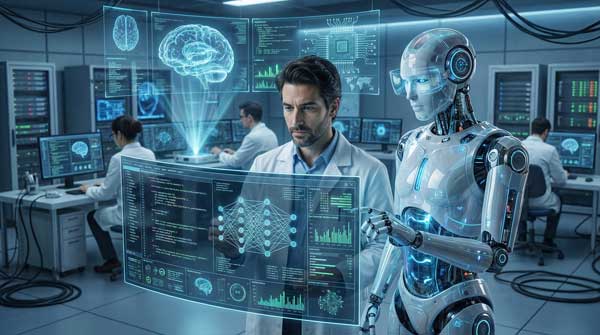
[Artificial intelligence. Photo Credit to Pixabay]
An R&D World Online’s article “6 ways AI reshaped scientific software in 2025,” published in December 2025, explains how artificial intelligence marked a turning point in the way scientific research is conducted.
For many years, artificial intelligence mainly served as a supporting tool that helped scientists calculate faster and organize large amounts of data.
However, in 2025, AI transcended assistance and became embedded in the core design of scientific software, shaping how experiments are designed, executed, and evaluated.
Across many research fields, AI systems are now able to suggest experimental conditions, adjust variables in real time, and identify patterns that human researchers might overlook, a shift already visible in AI-driven laboratory automation projects announced in early 2026.
As a result, scientific research is shifting away from step-by-step planning towards a process in which experiments continuously evolve.
This transformation affects not only the speed of research, but also the way scientific decisions are made, because AI systems now analyze experimental outcomes and recommend next steps based on patterns humans may not immediately recognize.
As AI begins to recommend which experiments should be conducted next based on continuous data analysis, the direction of research is increasingly shaped by both human judgment and algorithmic reasoning, rather than human intuition alone.
These changes extend beyond theoretical discussions.
In January 2026, Thermo Fisher Scientific announced a partnership with NVIDIA to expand AI-driven laboratory automation.
Through this collaboration, AI systems are being integrated directly into laboratory workflows, allowing experiments to be conducted with minimal human intervention.
Automated laboratories can now conduct repeated experiments, analyze results, and optimize future tests autonomously.
This demonstrates that the AI-centered research environment described by R&D World Online is already being implemented in real-world laboratories.
As AI assumes responsibilities in experimental design and data analysis, the role of human scientists is also undergoing a fundamental transformation.
A January 2026 analysis by MIT Sloan explains that AI is redefining what expertise means in knowledge-based fields, including scientific research.
In the future, scientists may be valued less for the manual processing of data and more for setting research goals, interpreting results, and making ethical judgments.
While AI may determine how an experiment is conducted, humans remain responsible for determining why the research matters.
This shift shows that scientists are moving from being operators of experiments to becoming designers and interpreters of scientific inquiry.
Since 2025, the future of scientific research has increasingly been shaped by collaboration between humans and artificial intelligence.
AI can design experiments and analyze outcomes, but it cannot take responsibility for the meaning or societal impact of scientific discoveries.
For students interested in science, this transformation carries an important message about the future of what it will mean to be a scientist.
Future scientists will need not only technical skills, but also the ability to think critically alongside intelligent systems.
As AI transitions from a background tool to a research partner, understanding how to guide and evaluate its role will be a key challenge for the next generation of researchers.

- Yehan Kim / Grade 9 Session 11
- Lexington High School