
![THE HERALD STUDENT REPORTERS [US]](/assets/images/logo_student_us.png)
![THE HERALD STUDENT REPORTERS [Canada]](/assets/images/logo_student_ca.png)

Foldable phone competition intensifies as Samsung pushes ahead and Apple signals entry
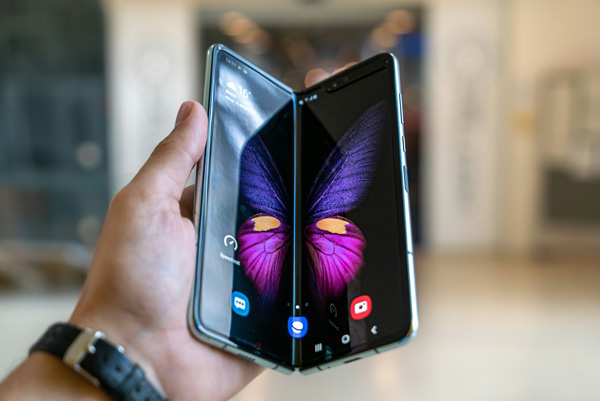
[A photo of a foldable phone. Photo Credit to Unsplash]
At CES 2026, Samsung unveiled the Galaxy Z TriFold, a groundbreaking three-panel foldable device that positioned itself as a practical hybrid between a smartphone and a tablet.
Unlike earlier foldables that prioritized thinness or novelty, Samsung framed the TriFold as a productivity-first device designed to replace both a traditional phone and a small tablet.
The Galaxy Z TriFold features a 10-inch internal display when fully unfolded and a 6.5-inch cover screen when closed, enabling it to function like a conventional smartphone for quick tasks.
Despite its larger footprint, Samsung says the device is just 3.9 millimeters thick at its thinnest point when open and weighs 309 grams.
The company also emphasized its multitasking features, including the ability to run three apps simultaneously and expanded support for Samsung DeX, which turns the device into a laptop-like workstation.
Samsung has already launched the Galaxy Z TriFold in parts of Asia and the Middle East, with a U.S. release scheduled for the first quarter of 2026.
The global competition for foldable smartphones is intensifying as Samsung expands its hardware lead and Apple signals a long-anticipated entry into the category.
While Samsung continues to drive the category forward, early reports have also reignited concerns about durability.
According to user reports on Samsung’s forums, at least one Galaxy Z TriFold owner experienced a spontaneous display failure within a month of purchase, despite there being no external damage.
The issue reportedly involved a line of dead pixels across one panel of the foldable display, raising concerns about hinge stress and panel longevity in first-generation tri-fold designs.
Currently, Samsung offers a one-time 50% discount on display repairs for the TriFold, though replacement costs remain close to $900 without insurance.
Ben Schoon, a technology analyst at 9to5Google, notes that spontaneous display failures are not unprecedented in early foldable devices and reflect the engineering challenges of scaling complex hinge mechanisms under repeated stress.
The durability debate is likely to shape broader consumer adoption as foldables move beyond early adopters and into higher-volume markets.
At the same time, Apple appears on the brink of entering the foldable phone race.
Supply-chain reports suggest Apple’s first foldable iPhone will incorporate liquid metal hinges and redesigned titanium alloys to enhance durability while minimizing weight.
Liquid metal, an amorphous alloy that Apple has researched for more than a decade, is believed to offer higher fatigue resistance than conventional metals, making it well suited for foldable hinges.
Apple is also expected to modify its titanium frame composition to balance strength and weight across a larger folding chassis.
The foldable iPhone is rumored to feature a book-style design with an approximately 7.8-inch internal display and a smaller outer screen, aligning it more closely with Samsung’s Galaxy Z Fold line than the TriFold.
Reports indicate Apple is targeting a fall 2026 launch alongside the iPhone 18 Pro lineup.
Pricing, however, may limit its appeal.
Industry estimates place Apple’s foldable iPhone at between $1,800 and $2,500, substantially higher than existing flagship phones.
Such a price positioning suggests Apple may initially target professionals and early adopters rather than mainstream consumers.
The divergent approaches highlight how competition in the foldable market is shifting from experimentation to execution.
Samsung is banking on scale, iteration, and ecosystem integration, while Apple appears focused on entering later with refined materials and tighter hardware control.
As foldables grow in size, price, and capability, the category is increasingly characterized by trade-offs between durability, portability, and productivity.
With Samsung already shipping next-generation designs and Apple poised to enter the market, the foldable phone race is entering a more consequential phase, one that may determine whether foldables remain a niche product or evolve into a core segment of the smartphone market.

- Yeojun Jung / Grade 10
- Chadwick International School