
![THE HERALD STUDENT REPORTERS [US]](/assets/images/logo_student_us.png)
![THE HERALD STUDENT REPORTERS [Canada]](/assets/images/logo_student_ca.png)

Iran’s retaliatory strikes have upended the lives of students at international schools in Dubai
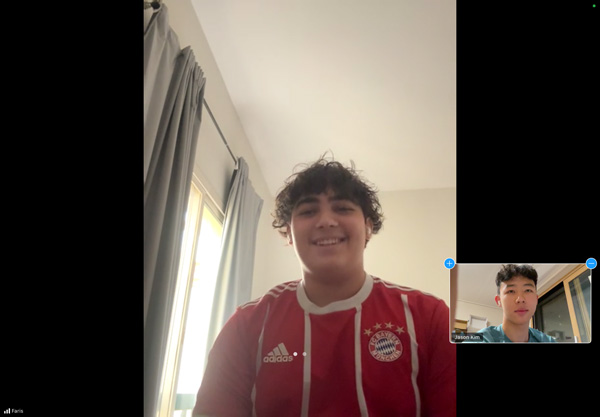
[A screenshot of an online interview with a resident of Dubai. Photo Credit: Jason Kim]
Faris was in his second period class in Dubai on the morning of February 28, 2026, when his international school announced that Iran had started to retaliate against US and Israeli airstrikes by firing projectiles at several Gulf Arab states, including the UAE, Dubai, Bahrain, Qatar, Kuwait, Saudi Arabia, and Oman.
Midway through the schoolday, classes were canceled and all students were advised to return home immediately.
Here is a firsthand account from a resident of the Gulf state on the retaliatory strikes that Iran has conducted on Dubai since the war started and how it has affected the lives of international students there.
The interview was conducted via Zoom on Tuesday March 24, 20026.
When asked how the conflict between the US and Iran affected students’ daily school life, Faris explained that on the first day, classes were canceled halfway through, and that all students were sent home immediately.
Since then, “learning has become much harder because everyone is distracted and stressed.”
“It feels similar to COVID online learning, but now there is more pressure because we are older and our classes are more important.”
“Many tests have been postponed as teachers fear that students would use AI tools for an advantage if online tests and assignments were offered, which means we will have to take a landslide of postponed exams all at once later, increasing the workload and stress.” he added.
As the United Arab Emirates has become a premier tourist destination, drawing millions of visitors from all corners of the world, the safety of living in the region has also become a concern and Faris assured me that he feels safe because, “the government has strong defense systems that have intercepted over 1,500 missiles and drones.”
“However, at the same time, I still feel nervous because you can hear loud interception sounds and emergency alerts, which can be stressful and unsettling.”
As Faris attends an international school in Dubai, the students' perspectives might be different from each other, and he admits that the situation for them does somewhat differ from others, as some students have the opportunity to return to their home countries, He states that right now, about half of the school has left the country.
He has not personally witnessed any missile or drone attacks, he gets repeated alerts from the government about “interceptions happening near my area and some debris from interceptions has reportedly fallen nearby, which made the situation feel more real.
The government is taking precautions to protect its people and country by mostly sending out mass alerts telling people to stay home during potential threats and only go out when necessary.
The government is very focused on maintaining control and preventing panic; however, it is also also enforcing strict rules about not filming or spreading information about attacks without permission to prevent misinformation.
People can be fined or even jailed for sharing false information. Overall, the government is focused on keeping the situation under control and preventing panic.
When asked if he and his family are considering leaving the country where Faris was born and lived his entire life due to the danger from missiles or drones, Faris said that, “At one point, my family considered leaving temporarily for about two weeks to see how the situation would develop.
However, since things improved and the country appeared stable, we decided to stay. If the situation had gotten worse, we would have likely moved to another country for safety.”

- Jason Kim / Grade 11
- Yongsan International School of Seoul