
![THE HERALD STUDENT REPORTERS [US]](/assets/images/logo_student_us.png)
![THE HERALD STUDENT REPORTERS [Canada]](/assets/images/logo_student_ca.png)

Baltimore bridge collapse triggers federal investigation and push for infrastructure safety
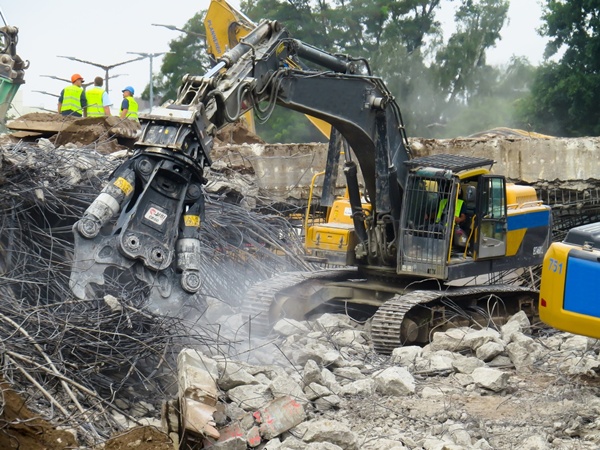
[A construction site. Photo Credit to Pxhere]
New details have emerged regarding the March 26, 2024 collapse of the Francis Scott Key Bridge, pointing to a mechanical failure triggered by a crew error hours before the vessel set sail.
The disaster occurred when the Dali, a Singapore-registered container ship, lost power and struck a support pier.
The impact resulted in the total collapse of the structure, which spanned the lower Patapsco River and the outer Baltimore Harbor.
Investigators determined that the ship’s technical issues began approximately 10 hours before departure following a power blackout.
During subsequent maintenance, a crew member accidentally closed an exhaust damper.
This error eventually caused the ship to lose power while underway, stripping the crew of the ability to maneuver the massive vessel as it approached the bridge.
The Francis Scott Key Bridge had been a fixture of the Baltimore skyline since it opened on March 23, 1977.
As the second-longest bridge in the city, it crossed the lower Patapsco River, the outer Baltimore Harbor and Port.
It was originally constructed to carry the Baltimore Beltway, also known as Interstate 695, between Dundalk and Hawkins Point, to make traveling around the city faster and easier.
This incident led to the the death of six members of a maintenance crew, one injured who was later rescued from the river, and an inspector was rescued from the bridge remains.
For the following 11 weeks, shipping to and from the Port of Baltimore was suspended, affecting more than 8,000 jobs and also blocked the Patapsco River shipping channel, shutting down nearly all port traffic.
In fact, the economic impact of the closure of the waterway was estimated to be $15 million per day.
Maryland officials predict the full repair of the bridge to be completed by 2030, estimating a cost of $4.3 billion to $5.2 billion.
Thousands of workers faced temporary layoffs as cargo movements were suspended.
Following this incident, The National Transportation Safety Board (NTSB) led a federal investigation into the cause of the collapse.
It was soon discovered that it was a loose signal wire aboard the Dali that set off the initial power outage leading to the failure of the vessel's engine or motor.
The NTSB later also found that this was a result of insufficient safety measures on the ship’s electrical systems, which caused multiple blackouts.
Officials claimed that the crew acted appropriately, but limited time restricted them from regaining control before the accident.
The investigation also criticized the Maryland Transportation Authority for not conducting a recommended vulnerability assessment of the bridge in previous years.
In response, federal and state officials have announced plans to rebuild the bridge with enhanced safety measures, including stronger pier protection and stability.
The NTSB has also proposed expanding safety recommendations for all vulnerable bridges nationwide to prevent similar accidents.
Furthermore, transportation experts are urging officials to conduct more frequent and thorough inspections of key infrastructure near busy shipping lanes to prevent future accidents.
The collapse of the Francis Scott Key Bridge has become one of the most severe infrastructure disasters in recent U.S. history, and unfortunately still has ongoing investigations and community impacts.
Citizens continue to demand for more safety measures to be taken regarding both shipping and bridge design as a result and officials have yet to address all safety concerns of citizens in Baltimore.

- Kylie Park / Grade 10
- Korea International School