
![THE HERALD STUDENT REPORTERS [US]](/assets/images/logo_student_us.png)
![THE HERALD STUDENT REPORTERS [Canada]](/assets/images/logo_student_ca.png)

Empathy matters in a divided society
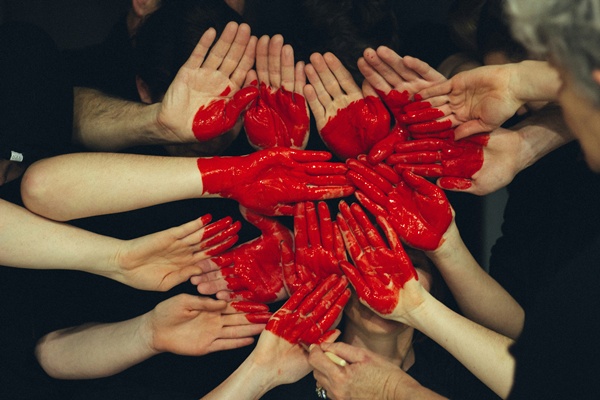
[An image of painted hands formed a heart. Photo Credit: Unsplash]
Social media is intensifying political polarization in the United States, according to a report from the NYU Stern Center for Business and Human Rights.
Disagreements about politics, race, religion, and social issues often turn into arguments rather than meaningful conversations.
Consequently, people may stop trusting each other and begin to see those with different opinions as enemies.
In this environment, empathy becomes particularly important for understanding another person’s perspective.
Empathy is commonly defined as the ability to understand and share the feelings of others.
Psychologists explain that there are different types of empathy, including understanding someone’s perspective and emotionally connecting with their experiences.
Empathy does not imply agreement or an excuse for harmful behavior.
Instead, it means recognizing that others have different experiences and perspectives.
Empathy can reduce stereotypes and prejudice.
When individual cease efforts to understand others, they often resort to generalizations about entire groups.
These stereotypes can lead to unfair treatment and deeper division within society.
Research shows that when individuals are encouraged to see things from another person’s point of view, they are less likely to hold prejudiced attitudes.
This suggests that empathy can help people see others as individuals rather than labels, which often polarize society.
For instance, arguments on social media about elections or public health often escalate quickly, with people dismissing opposing views.
However, discussions that encourage listening and understanding tend to remain more respectful, even when people disagree.
Empathy can also improve communication and reduce conflict.
In a divided society, people often assume the worst about each other, making honest conversations difficult.
Feeling understood is an important part of meaningful communication, according to psychologist Irarrázaval L.
When individuals feel heard and respected, they are more likely to listen in return.
Even if they still disagree, their conversations can become more respectful and productive.
Empathy promotes selfless behavior, such as helping others and working together.
Studies have found that people with higher levels of empathy are more likely to cooperate and resolve conflicts peacefully.
These skills are especially important when dealing with large social issues that require teamwork and understanding.
Empathy is especially relevant for high school students.
Teenagers, in particular, are constantly exposed to opinions and conflicts, especially on social media.
While these platforms can spread awareness, they also have the potential to increase division by encouraging quick and emotional reactions.
In this environment, empathy can help students slow down, think carefully, and communicate more respectfully.
Although empathy is important, it is not a complete solution to social problems.
Issues such as discrimination, inequality, and political conflict also require laws, education, and leadership.
However, empathy still serve as a necessary starting point.
Without it, people may become more hostile and less willing to work together, making real change harder to achieve.
Empathy is crucial in reducing division and improving communication in society.
It helps people challenge stereotypes, build trust, and work together to solve problems.
While it cannot fix everything on its own, empathy creates the foundation for a more understanding and respectful world.
In an era of growing division, empathy remains an essential skill, especially for young people.

- Noelle Chun / Grade 11 Session 12
- Marriotts Ridge High School