
![THE HERALD STUDENT REPORTERS [US]](/assets/images/logo_student_us.png)
![THE HERALD STUDENT REPORTERS [Canada]](/assets/images/logo_student_ca.png)

NASA spacecraft discovers once-in-a-lifetime lunar crater
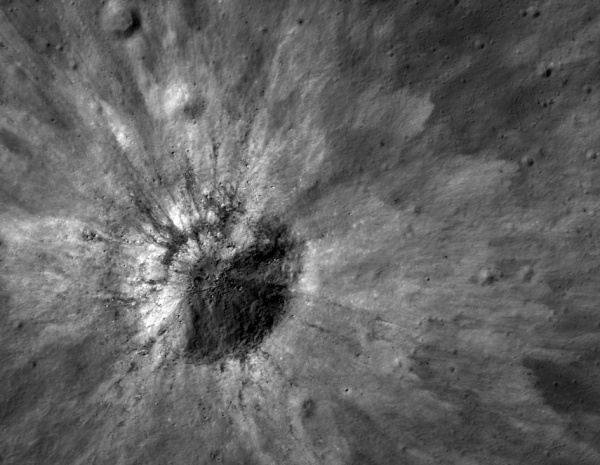
[A photo of a lunar crater. Photo Credit to Wikipedia Commons]
On September 16, NASA announced that images from its Lunar Reconnaissance Orbiter (LRO) had revealed a large lunar crater formed by a 2024 space rock impact.
The crater, now named after lunar scientist Tom McGetchin, is estimated to be 728 feet wide and 141 feet deep.
Scientists estimate that an impact large enough to create a similar crater is a once-in-a-centry event, making this discovery exceedingly rare.
The impact, which is estimated to have occurred between April 11th and May 22nd, 2024, was caused by a comet or asteroid believed to be the size of a three to six storey building on the eastern side of the moon.
Unlike Earth, the Moon lacks an atmosphere to slow or burn up incoming space rocks as they crash onto its surface.
Thus, the impact of the space rock created a large crater and sent lunar debris and soil into the surrounding space.
While scientists did not witness the impact taking place, they did discover it more than a year later by examining images taken by NASA’s LRO.
The spacecraft has orbited the Moon since 2009, and regularly transmits images of its surface from pole to pole back to NASA.
Throughout its 17-year lifespan, it has recorded over 1000 different impacts, and identified 100,000 changes to the Moon’s surface.
In October 2025, while image specialist Robert Wagner was conducting a routine comparison of the lunar surface on different dates, he noticed an unusually bright area surrounded by a dark ring, with this stark contrast suggesting that there had been a recent disturbance of materials.
Researchers then compared the images with previous recordings of the same area and confirmed that the detail had not existed previously.
The LRO’s high resolution camera was then used to photograph that specific area in high definition, which allowed NASA to determine the size of the crater and research the material that was displaced in the impact.
This research also revealed that the collision’s effect went far beyond the crater itself.
Further study into the crater involved measuring the temperature of the lunar rock surrounding McGetchin, where NASA’s Diviner instrument determined that a four-mile-wide section around the crater was about 16 degrees Fahrenheit cooler at night compared to the surrounding area.
Scientists confirmed that this phenomena, which they described as a “cold spot,” was caused by the impact disturbing the Moon’s loose lunar material called regolith.
The disturbance reduced the density of regolith in the area, causing it to lose its ability to maintain heat during the nighttime.
This cold spot shows that lunar impacts can alter the moon’s surface far beyond the initial impact area, providing scientists a better understanding of the lunar surface and paving the way for more expansive research.
“Here we see a crater that formed two years ago, so we know how it formed and how it is changing. This makes the new crater a very useful calibration point,” says planetary scientist David Paige.
By remaining in orbit around the moon and through continued examination of the crater, scientists will be able to determine how the lunar surface shifts and changes over time, providing valuable data that can be used in future missions and investigations.

- Ian Kim / Grade 11 Session 7
- R.E. Mountain Secondary School