
![THE HERALD STUDENT REPORTERS [US]](/assets/images/logo_student_us.png)
![THE HERALD STUDENT REPORTERS [Canada]](/assets/images/logo_student_ca.png)

Artemis II marks historic return to lunar exploration
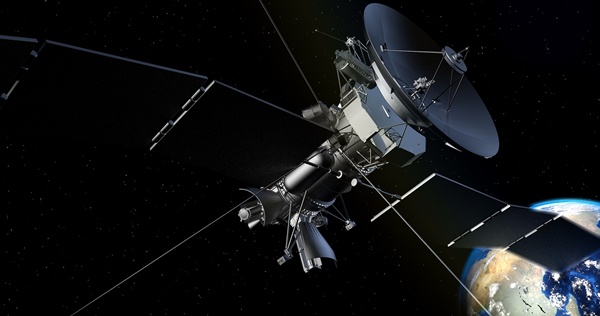
[Space satellite. Photo Credit: Pixabay]
NASA’s Artemis II mission has successfully returned to Earth after a record-breaking journey around the Moon on April 11, 2026.
The mission marks the first time humans have traveled to lunar orbit in over half a century.
Led by NASA, the flight serves as a crucial stepping stone for future missions to land on the lunar surface and eventually reach Mars.
The four-person crew consisted of Reid Wiseman, Victor Glover, Christina Koch, and Jeremy Hansen.
The team made history for its diversity, ushering in a new era of inclusive space exploration.
Christina Koch became the first woman to travel around the moon, achieving the farthest distance from Earth ever by a female astronaut.
Victor Glover became the first Black astronaut to complete a lunar flyby, while Jeremy Hansen became the first Canadian to do so.
During their 10 days aboard the Orion spacecraft, the crew tested vital life-support systems including oxygen supply and temperature control.
“It’s a special thing to be human, and it’s a special thing to be on planet Earth,” Reid Wiseman reflected after the mission.
A significant aspect of the journey was its free return trajectory, which used the Moon’s gravity to slingshot the craft back toward Earth.
This meant that even if the engines had failed, the laws of physics would have naturally guided the astronauts back home safely.
This fail-safe design made the mission much safer and more reliable for the crew.
While in space, the crew tested vital life-support systems such as oxygen supply, temperature control, and navigation.
These systems are necessary to keep astronauts alive and safe during multi-year missions planned for the future.
The crew also conducted research on how deep space affects the human body, particularly when traveling far from the protection of Earth’s magnetic field.
The spacecraft traveled about 406,771 kilometres from Earth, making it one of the farthest distances humans have ever ventured.
During the return journey, the Orion capsule entered Earth’s atmosphere at a remarkable speed of 40,000 kilometers per hour.
The exterior became extremely hot upon re-entry, but a high-tech heat shield successfully protected the crew from the intense thermal energy.
Upon their return, the astronauts required assistance walking as their bodies readjusted to the pull of gravity.
Doctors are now overseeing their recovery, and the crew is expected to return to their normal physical routines shortly.
Artemis II is part of a larger initiative called the Artemis program, designed to establish a long-term human presence on the Moon.
The next phase, Artemis III, is scheduled to land astronauts on the lunar surface for the first time in over five decades.
Ultimately, scientists hope to establish a lunar base that will serve as a launchpad for the first human journey to Mars.
Overall, the success of Artemis II proves that humanity is ready to explore deep space once again.
This mission is not just about returning to the Moon; it was a demonstration of the technology and teamwork required to explore humanity’s place in the universe.

- Hayul Lee / Grade 9 Session 5
- London Central Secondary School