
![THE HERALD STUDENT REPORTERS [US]](/assets/images/logo_student_us.png)
![THE HERALD STUDENT REPORTERS [Canada]](/assets/images/logo_student_ca.png)

Trump’s push to Greenland exposes the fragility of liberal world order
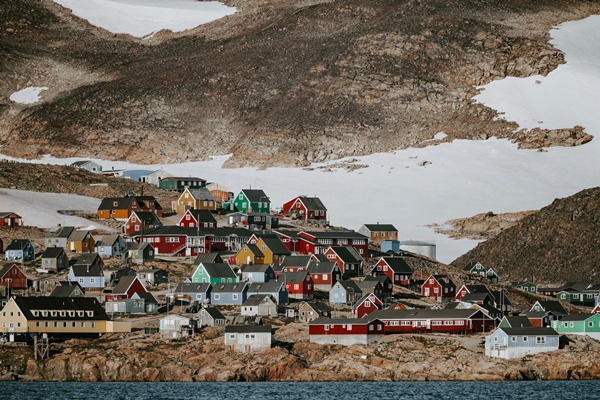
[Greenland, Photo credit: UnSplash]
Following his 2024 re-election, in January 2026, US President Donald Trump renewed calls for the United States to acquire Greenland, framing the move as a matter of “national security” and that he "no longer [felt] an obligation to think purely of Peace" after not receiving the Nobel Peace Prize.
Trump’s proposal has been firmly rejected by Greenlandic Prime Minister Jens-Frederik Nielsen and Danish Prime Minister Mette Frederiksen, who both described their sovereignty as a “red line.”
At its core, Trump’s push into Greenland centers around the belief of “America First,” prioritizing American interests above other states.
Greenland, a semi-autonomous territory within the Kingdom of Denmark, covers roughly 2.2 million square kilometers and has a population of approximately 56,000 people, the majority of whom are Indigenous Inuit.
Despite its small population, the island holds significant strategic value for the US due to its Arctic location and the existing US-operated Pituffik Space Base, which monitors missile activity.
Earlier this year, Trump commented in Davos that the United States “should have kept” Greenland after World War II and claimed that only the US could adequately protect and develop the territory, according to BBC News.
This statement aligns with the principles of offensive realism, which often focuses on the maximization of one’s own state’s power in a presumed anarchic society.
Trump’s tactics that are being used to carry out this goal also align with offensive realism.
Trump’s foreign policy is built around national sovereignty, including the use of coercive force to change external borders; or, in other words, controlling the sovereignty of other states for one’s own benefit.
According to The Economist, in November of 2025, Trump communicated to foreign governments that conducting business against US interests could trigger immediate tariffs of up to 25 percent, reinforcing the use of coercive power to gain economic leverage.
Regarding the case of Greenland, in January of 2026, Trump threatened 10 percent tariffs on several European allies if they did not support him, later withdrawing the proposal after what he described as a “framework” agreement with Nato Secretary General Mark Rutte.
Trump’s approach essentially challenges the liberal world order, a concept that scholars have extensively discussed.
Liberal world order is defined as the idea that all nations would become members of a community, one human family, and citizens of the world.
Centered around the ideology of liberalism, it assumes that states benefit from shared rules, collective security, and legal norms that limit coercion, emphasizing interdependence.
Trump’s approach appears to challenge these ideas.
Rather than viewing international law as a moral blueprint for states to follow, he has often prioritized US strategic interests over it.
Recently too, in January and February of 2026, Trump repeatedly claimed that the US is “treated very unfairly” in global politics despite giving “so much,” raising international concerns about interdependence and collective security.
According to The New York Times, a few days ago, Danish Prime Minister Frederiksen condemned Trump’s US, firmly stating in his speech that “the old world order is now gone.”
Greenland’s future, hopefully, ultimately depends on the decision of the Greenlanders, as both Copenhagen and Nuuk have reiterated.
However, broader political and social implications extend beyond Greenland.
The dispute may illustrate a shift from a norm-based international system toward a power-based system where outcomes are determined by coercive power in an increasingly anarchic society.
Whether this represents realism or the erosion of international order, it will define the next century of global politics.

- Jeongmin Kim / Grade 11
- Chadwick International School