
![THE HERALD STUDENT REPORTERS [US]](/assets/images/logo_student_us.png)
![THE HERALD STUDENT REPORTERS [Canada]](/assets/images/logo_student_ca.png)

Study finds tennis is the best sport for longevity
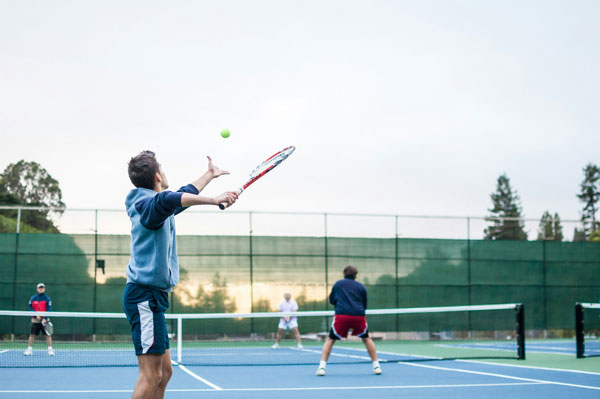
[People playing tennis on an outdoor tennis court. Photo Credit to Unsplash]
According to the Copenhagen City Heart Study presented in the Mayo Clinic Proceedings, looking up 8577 participants for a maximum of 25 years, they found that racket sports such as tennis and badminton extend life expectancy more than any other sport.
Looking at each sport, tennis had an extended average of 9.7 years of life expectancy, and badminton had an average of 6.2 years.
These are significantly higher than those for other non-racket sports, such as soccer (4.7 years), jogging (3.2 years), and swimming (3.4 years).
Furthermore, tracking over 80000 people for nine years in the “British Journal of Sports Medicine” also indicated that people who enjoy tennis, badminton, racketball, and even table tennis had a 47% lower overall risk of death compared to others.
These sports were more effective than other aerobic activities such as jogging, swimming, and cycling.
However, both datasets are observational studies that can’t prove causal relationships, so rather than concluding that there is a causal relationship, experts estimate there is an association between them.
The reasons for these outcomes are analyzed by analysts through 2 main factors.
First, tennis strengthens the heart and lung functions by continuously increasing the heart rate.
Tennis is a sport that requires people to run, chase the ball on the court, and swing the racket as they play the game.
Unlike other aerobic sports that require regular exercise at the same pace, tennis players obtain higher exercise intensity and cardiorespiratory stimulation by stimulating the body systems gradually.
More than that, tennis is a full-body workout.
It has the widest range of activity on the court among racket sports, and as one changes the body direction to hit the ball, the lean muscles and other cardio-vascular functions are strengthened simultaneously.
Second, tennis provides the opportunity for social interaction and bonding through clubs and recreational groups.
Tennis requires a partner to play against, and together, the natural social interactions become the main motivation to keep playing the sport and stay connected with the community.
Furthermore, tennis also activates our brains as well.
Tennis requires players to predict opponents' movements and the trajectory of the ball, and makes people think about which course to send the ball.
The popularity of tennis is steadily increasing.
The USTA (United States Tennis Association) announced that the tennis population in the United States increased by 1.6 million in 2025 to eclipse a new high of 27.3 million total players.
From 2019 to 2025, tennis participation in the U.S. has grown by 54 percent, with 10 million players added over six consecutive years. The USTA has set its goal of over 35 million tennis participants by 2035.
The main reasons for this increase in popularity are estimated to be the spread of opportunities for diverse communities and the inflow of MZ generations.
Last year, in 2025, participation by women increased by 1.1 million more, up 10%; Black people (450,000, up 14%); Hispanics (550,000, up 12%); and Asian/Pacific Islanders (260,000, up 10%). There was a significant increase in population, not only concentrated in the European and U.S. states.
With the barrier to entry for tennis becoming easier and the sport’s health benefits, its popularity remains constant across every generation.

- Jiyule Shin / Year 8
- North London Collegiate School Jeju