
![THE HERALD STUDENT REPORTERS [US]](/assets/images/logo_student_us.png)
![THE HERALD STUDENT REPORTERS [Canada]](/assets/images/logo_student_ca.png)

Nota speeds up robotic arm tasks with Qualcomm NPU
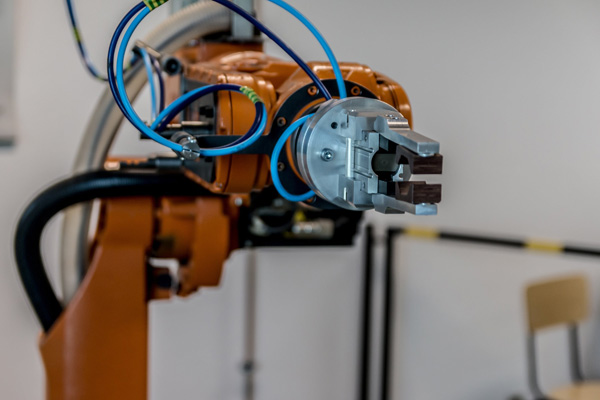
[robot-arm-technology-robot-arm Photo credit to Pixabay]
On September 22, AI model optimization company Nota announced that it had successfully adapted and optimized its robotics AI for Qualcomm’s Neural Processing Unit (NPU), tripling the operating speed of a robotic arm in real-world tests.
Nota optimized its Vision-Language-Action (VLA) model using the NPU in Qualcomm’s industrial system-on-chip (SoC), the Qualcomm Dragonwing IQ-9075.
A Vision-Language-Action (VLA) model is an integrated AI model that enables robots to interpret visual data, understand language commands, and directly generate physical actions, such as control signals.
Nota announced on September 22 that, as a result of this optimization, the robotic arm’s task completion time was reduced from 36 seconds to 12 seconds.
In the experiment, Nota tested a task in which the robotic arm interpreted a spoken instruction, picked up a cube, moved it from its original position, and placed it on a mat on the opposite side.
Thanks to the optimization, the AI’s inference speed for determining its next action increased by up to sevenfold.
Despite the significant increase in speed, the task success rate fell by only one percentage point, from 93% before optimization to 92%, minimizing the performance loss.
This means that the optimization not only sped up the system, but also preserved most of the original model’s performance, resulting in a system that was both fast and accurate.
In particular, the system performed AI inference directly on the Qualcomm NPU connected to the robot, without relying on a high-performance GPU or an external server.
Typically, AI performance is often limited without high-performance GPUs or external servers, posing significant challenges for such systems.
Despite these challenges, Nota optimized both the AI model and its runtime environment so that the robot could process everything internally, from camera-based visual recognition and language-command understanding to action generation.
As mentioned earlier, a VLA model understands both visual and language inputs and uses them to generate real-world robotic actions.
However, this process requires significant computing power and memory, running the model entirely on a robot with limited power and resources requires optimization not only of the AI model itself, but also of the underlying hardware and runtime environment.
Nota implemented several optimizations to enable the VLA model to run entirely on the robot’s onboard hardware, including model compression, NPU computation optimization, a multi-NPU runtime environment, and accelerated action generation.
The optimized system was then connected to a physical robotic arm to comprehensively evaluate its AI inference speed, task execution speed, accuracy, and task success rate.
AI inference speed also affects a robot’s responsiveness, because delayed decision-making can cause the robot to act based on outdated information even after its surroundings have changed, potentially leading to errors.
In particular, for AI models trained to control a robot’s continuous movements, faster inference can also enhance stability during real-world tasks.
Building on this achievement, Nota plans to expand its optimization technologies developed in mobile and edge AI into the field of physical AI, including robotics and humanoid systems.
Established in 2015 by researchers from KAIST, Nota initially focused on developing technology to reduce typing errors on smartphone keyboards and has since expanded its business into AI model optimization technologies that enable efficient AI operation even on small devices.
Its flagship technology is NetsPresso, an automated AI model compression and optimization platform.
It reduces model size and computational requirements while minimizing performance degradation, enabling AI models to operate effectively in on-device environments with limited power and computing resources.
Nota currently partners with major technology companies including Samsung Electronics, LG Electronics, and Naver, as well as global semiconductor and technology firms such as NVIDIA and Qualcomm.
Nota is also participating in a government-funded humanoid robotics project under South Korea’s K-On-Device AI Semiconductor Technology Development Program.
In this project, Nota is focusing on optimizing Vision-Language-Action models for domestically developed NPUs and real-world robotic environments.
“This case demonstrates that optimization can go beyond simply reducing AI model size or improving inference speed and translate into better responsiveness and task performance in real-world robots,” explained Nota CEO Myung-soo Chae.
Chae further elaborated, “We plan to expand our optimization technologies across a wide range of AI models and hardware platforms into the field of physical AI, including robotics and humanoids.”

- Yongjun Cho / G12
- The American School of Bangkok Green Valley