
![THE HERALD STUDENT REPORTERS [US]](/assets/images/logo_student_us.png)
![THE HERALD STUDENT REPORTERS [Canada]](/assets/images/logo_student_ca.png)

NASA begins a new era of space exploration
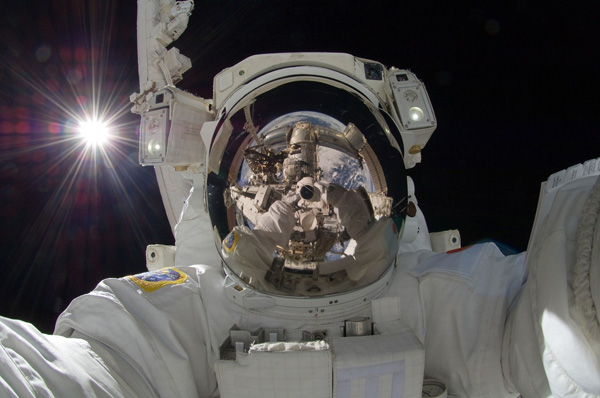
[Astronaut taking a selfie. Photo Credit to Pxhere]
On April 1, 2026, NASA launched Artemis II from the Kennedy Space Center, sending four astronauts Reid Wiseman, Victor Glover, Christina Koch, and Canadian Space Agency astronaut Jeremy Hansen around the moon aboard the Orion spacecraft.
Following a successful lunar flyby, the crew returned safely to Earth on April 10, setting a new record for the farthest distance humans have ever traveled from Earth.
The Artemis program is not something recent, as it was first announced by NASA in 2019, quickly gaining much attention and popularity for being the first time sending astronauts to the moon since Apollo 17 in 1972, over 50 years ago.
The main goal of the Artemis program is to establish a sustainable human presence on and around the moon and utilize the experience gained there as a stepping stone for deeper space exploration.
The Artemis II crew was announced in April 2023 and began training together later that year, spending approximately three years preparing through spacecraft training, emergency procedures, simulations, and other exercises designed to prepare them for the challenges of deep-space travel.
Although the selected astronauts trained together for around three years, NASA’s Orion spacecraft, Space Launch System rocket, and other components of the Artemis program had already been under development for many years before the crew was selected.
However, the journey to launch was certainly not an easy task.
For several years, engineers conducted rigorous testing of Orion’s heat shield, life support system, safety regulations, navigation software, and communication equipment to ensure that the spacecraft could operate properly during a crewed mission far from Earth.
On April 1, 2026, Wiseman, Glover, Koch, and Hansen spent 10 days aboard Artemis II, following a free-return trajectory that carried Orion around the far side of the Moon before the combined gravity of Earth and the Moon guided the spacecraft back toward Earth.
During the mission, reseachers evaluated Orion’s performance under crewed deep-space conditions by testing components such as life support systems, navigation, and communication with Earth.
A major priority of Artemis II was to determine how well Orion could support astronauts during extended missions beyond low-Earth orbit and to collect information that could help NASA prepare for future missions to the Moon and eventually Mars.
The crew also collected data on astronaut health, radiation exposure, workload, and daily operations in deep space, providing scientists and engineers additional data that cannot be fully reproduced in Earth-based testing.
Additionally, this journey around the moon allowed scientists and engineers to gather information valuable to creating and operating spacecrafts far away from Earth.
However, the significance of this mission extended beyond the valuable data it collected.
Artemis II made history by carrying Christina Koch, the first woman to participate in a lunar mission; Victor Glover, the first person of color to participate in a lunar mission; and Jeremy Hansen, the first Canadian to travel on a lunar mission.
After 10 days in space, Orion and all four astronauts returned safely back to Earth on April 10, successfully concluding the Artemis II mission.
NASA’s Artemis program is far from finished.
With the information and experience gained from Artemis II, NASA hopes to return astronauts to the lunar surface on the Artemis III mission.
Beyond this, the Artemis has also provided much progress in preparing humanity for future exploration not only on Mars but also other destinations in space.
The successful completion of Artemis II therefore represented both a major step in NASA’s return to the Moon and an important test of the systems that could support future human exploration farther into space.

- Kylie Park / Grade 11
- Korea International School