
![THE HERALD STUDENT REPORTERS [US]](/assets/images/logo_student_us.png)
![THE HERALD STUDENT REPORTERS [Canada]](/assets/images/logo_student_ca.png)

Physical AI is quietly moving out of the lab into daily life
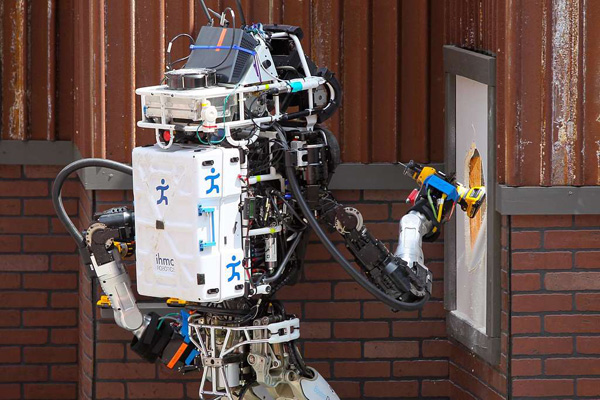
[A robot learning and working on human tasks. Photo Credit to DVIDS]
On April 19, 2026, a humanoid robot named Lightning crossed the finish line of a 21-kilometer half-marathon in Beijing’s E-Town district in 50 minutes and 26 seconds.
The robot, developed by Chinese smartphone manufacturer Honor, competed using autonomous navigation and was declared the winner of the robot race.
The result demonstrated remarkable progress in humanoid locomotion.
Lightning maintained its balance, navigated a designated course, and managed the heat produced during nearly an hour of high-speed movement.
Its liquid-cooling system and legs designed to mimic those of elite runners also helped it maintain its pace over the long distance.
The race was not, however, an uncontrolled test of a robot operating independently in an unpredictable public environment.
While both human runners and robots followed the same overall route, they were separated by barriers or green belts.
Robots were dispatched at intervals, and each one was accompanied by a judge in a golf cart who monitored rule violations, battery replacements and penalties.
Lightning’s performance has drawn attention to physical AI, a field that applies artificial intelligence to machines operating in the physical world.
Unlike traditional robots, which repeatedly follow fixed instructions in highly structured settings, physical AI systems are designed to perceive their surroundings, make decisions and adapt their actions to changing conditions.
Daniela Rus, director of MIT’s Computer Science and Artificial Intelligence Laboratory, explained that physical AI emerges when AI’s ability to understand text and images is coupled with an understanding of the physical world and used to make physical machines more intelligent.
Robots have been used in factories since the 1960s, but most early industrial robots were designed to complete a narrow set of repetitive tasks.
They usually worked in controlled environments and could fail when an object or situation differed even slightly from their programming.
So why does physical AI today feel so different from the robots of the past?
The answer lies in the development of foundation models that enable generalization, simulation advances that compress training cycles from years to hours, a self-reinforcing data where robots generate data that improves the models, and the fall of hardware costs that increased humanoid production.
Deepu Talla, the Vice President and General Manager of Robotics at Edge AI at NVIDIA, stated that in the last 12 to 24 months, technologies of foundation models and simulation reached a level of maturity.
He also claims that this development brought the industry into what he called the “golden age for physical AI and robotics.”
The Beijing Marathon event highlighted advancements in several specific areas.
Lightning demonstrated that a humanoid robot could sustain rapid movement over a long distance, maintain balance across slopes and curves, regulate its temperature and navigate a predetermined route without continuous remote control.
Physical AI marks a great development in artificial intelligence technology, but challenges still remain.
Reliability remains as the grand challenge in the field, as robots still struggle to reliably estimate the basic physical properties like distance, orientation, and object size.
Models that excel in controlled settings and simulations often fail in real-world conditions.
Although Lightning’s run was impressive, the robot’s race took place in a controlled, separate track for robots.
What the half-marathon actually showed was the humanoid’s ability to perform long-distance running, maintain balance, and to cool itself down when overheated.
Dexterity, which is the ability to handle varied objects, soft materials, or tasks requiring fine motor control, remains a major constraint.
Researchers are investigating ways to integrate humanoid robotics with large AI models and embodied AI systems, enabling robots to better understand and interact with human environments.
The next frontier for physical AI research is not speed or endurance, it is the capability of AI to adapt better into unpredictable environments.
TorqueAGI, the physical AI company founded by Dr. Ashutosh Saxena, is built on the premise that robots should master new tasks with 1000 times less data than conventional approaches and should show reliable perception, reasoning, and planning in real-world conditions.
The finish line that Lightning crossed was a headline, but the research happening right now, on better physical reasoning, dexterity, and tactile sensing, will determine if physical AI will become the infrastructure of daily human life or will remain as a very impressive demo.

- Juhwan Kim / Grade 9
- Fayston Preparatory School