
![THE HERALD STUDENT REPORTERS [US]](/assets/images/logo_student_us.png)
![THE HERALD STUDENT REPORTERS [Canada]](/assets/images/logo_student_ca.png)

World leaders convene at UN General Assembly to establish historic AI guardrails
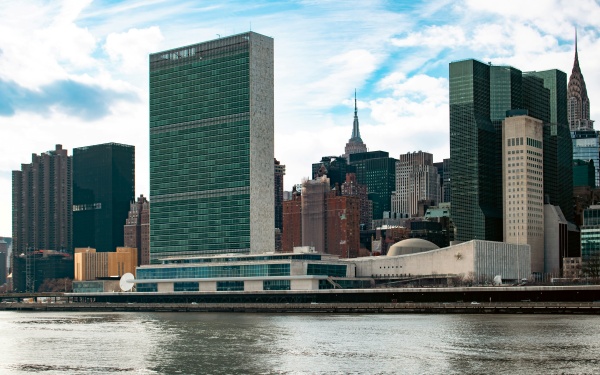
[UN headquarters in New York City. Photo credit to Unsplash]
In late September, international delegations convened at the United Nations Headquarters in New York for the 81st Session of the UN General Assembly (UNGA).
The central focus of high-level ministerial discussions shifted decisively toward establishing legally binding global governance frameworks for artificial intelligence.
As rapid advancements in machine learning systems transform commerce, diplomacy, and defense, world leaders emphasized that unchecked algorithms now pose unprecedented challenges to international peace, institutional integrity, and basic human rights.
Briefing papers and policy declarations published by the United Nations (UN News) indicate that member states formally prioritized multilateral oversight over private self-regulation.
UN officials emphasized that while advanced automated systems offer transformative solutions for scientific discovery and economic growth, they also pose urgent risks.
These hazards include algorithm-driven misinformation campaigns during national elections, deepfake-assisted fraud, autonomous cyber weaponry, and systemic biases that exacerbate global socioeconomic inequality.
The assembly emphasized that unilateral domestic legislation is no longer adequate to govern digital technologies that operate without physical borders.
Data presented by the Organisation for Economic Co-operation and Development (OECD) and UNESCO highlighted an alarming divide in technological capacity between wealthy industrialized nations and developing countries.
The reports revealed that more than 82 percent of advanced computing clusters and high-tier semiconductor manufacturing patents remain concentrated within just four industrialized economies.
Representatives from the Global South cautioned that without multilateral standards guaranteeing open-access development tools and shared technical training, developing nations risk falling into persistent digital dependency.
Furthermore, human rights observers presented evidence detailing how unregulated facial recognition software and algorithmic profiling have been deployed across vulnerable regions without statutory oversight or transparent judicial appeals.
International policymakers and computer scientists stressed the immediate necessity of binding verification procedures over voluntary corporate pledges.
"Artificial intelligence cannot remain a regulatory blind spot where individual corporations establish standards for the rest of humanity," Melissa Fleming, Under-Secretary-General for Global Communications, stated.
She emphasized that international cooperation must prioritize independent auditing protocols to verify whether commercial language models comply with fundamental human dignity, data privacy protections, and safety thresholds before large-scale public deployment.
Legal scholars closely following the proceedings noted that sovereign defense applications represent the most contentious area of international negotiation.
"Autonomous decision-making in weapon systems strips away human moral accountability from life-and-death encounters," explained Dr. Stuart Russell, a leading computer scientist and AI safety researcher.
He reiterated that the international community must establish a clear global treaty prohibiting lethal autonomous systems that operate without meaningful human control, comparing the necessity of these restrictions to historic treaties governing non-proliferation and chemical disarmament.
In response to these warnings, member states drafted an initial resolution outlining a permanent United Nations international scientific advisory panel on artificial intelligence.
This body will be tasked with conducting biannual technical evaluations of cutting-edge computing architectures and establishing interoperable safety benchmarks across national borders.
In addition, the draft agreement proposes an international technical assistance fund designed to provide educational grants, regional computing infrastructure, and localized dataset development for low-income countries.
Government delegates and civic organizations affirmed that safeguarding technological progress demands proactive international consensus.
Experts concluded that without enforceable multilateral standards, the rapid proliferation of unmonitored artificial intelligence systems will widen the digital divide and destabilize international security architectures for generations to come.

- Juwon Jung / 11th grade
- Christian Sprout Intercultural School