
![THE HERALD STUDENT REPORTERS [US]](/assets/images/logo_student_us.png)
![THE HERALD STUDENT REPORTERS [Canada]](/assets/images/logo_student_ca.png)

The Hormuz crisis is turning renewable energy from a climate ideal into a national security imperative
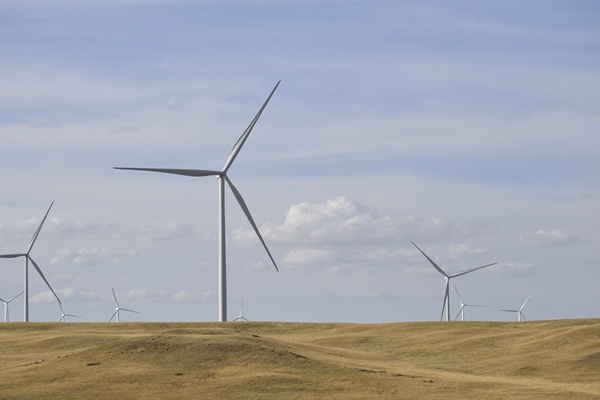
[Image of Windmills, Credit to Pixabay]
International Energy Agency Executive Director Fatih Birol stated on March 23 that the Strait of Hormuz crisis will drive "an acceleration of renewables," reframing solar and wind not as climate tools but as national security assets. The four-week-old blockade of the world's most critical energy chokepoint pushes governments from Pakistan to Spain to rethink fossil fuel dependence, while countries like South Korea and the Philippines that underinvested in domestic energy face stock market crashes, fuel rationing, and national emergencies.
Speaking at Australia's National Press Club, Birol noted that 85 percent of all new power capacity installed globally last year came from renewables. "Ten years ago, solar was a romantic story," he said. "Now solar is a business.”
Birol’s remarks came as the Hormuz crisis entered its fourth week. U.S. and Israeli strikes on Iran on February 28 triggered an effective shutdown of the Strait, cutting off roughly a fifth of global oil and gas supply.
Brent crude prices surged to $126 a barrel, and the IEA has called it the largest supply disruption in the history of the oil market.
What distinguishes this crisis from the oil shocks of the 1970s is that viable alternatives actually exist now.
In 1973, there were no realistic alternatives to oil at scale.
In 2026, solar energy has become the cheapest source of new electricity in most of the world, battery costs have dropped dramatically, and electric vehicle adoption is accelerating across Asia.
The technology is ready. The question has always been about political will.
That political will appears to be emerging, not through climate summits or emissions targets but through the raw logic of economic survival.
When a country is four weeks into an energy crisis because a 21-mile-wide waterway on the other side of the world shut down, the appeal of generating power domestically stops being theoretical and becomes a tangible necessity.
The proof is already evident in which countries are weathering the crisis and which are not.
The split does not follow the usual lines of rich versus poor.Rather, it follows a simpler pattern: those who invested in domestic energy before the crisis hit, and those who kept betting on imported fossil fuels.
Pakistan, not a country typically associated with energy resilience, has been partly insulated by a rooftop solar boom that reportedly helped it avoid around $12 billion in oil and gas imports by February 2026.
Spain, where renewables now cover over half the energy mix, is posting some of the lowest gas prices in the EU.
On the other side are the countries now scrambling.
What these countries share is not poverty or lack of development but a specific policy choice: they kept pouring money into fossil fuel infrastructure while treating renewables as a secondary priority.
South Korea directed roughly 141 trillion won toward fossil fuels over the past eleven years, compared to just 11 trillion for renewables.
When the Strait closed, its stock market crashed 18 percent in four days.
The Philippines, which imports up to 98 percent of its oil from the Gulf, declared a national energy emergency on March 24.
South Korea’s reaction present a painful irony.
Rather than using the crisis as a catalyst for the renewable transition it has long delayed, the government is restarting nuclear reactors and considering more coal.
This is understandable when the need is for power next week, not next year.
However, it also raises a deeper question about whether crises truly change policy or merely reinforce the path a country was already on.
It is also worth being honest about the limitations of renewables here.
Solar and wind produce electricity. What flows through Hormuz is mostly crude oil for vehicles and petrochemical feedstocks that go into plastics, fertilizers, and industrial chemicals.
No amount of solar panels will replace naphtha.
The energy transition is real, but it is not a switch that can be flipped overnight, and pretending otherwise does not help anyone.
Still, the fundamental direction of the argument has shifted in a way that probably will not reverse.
For decades, renewable energy advocates made their case in the language of carbon emissions and global temperatures.
Those arguments gained traction at a gradual pace.
The Hormuz crisis is making the same case in a language that governments respond to much faster: national security, economic survival, and the basic question of whether your country can keep functioning when a shipping lane shuts down.
As one researcher remarked to NPR: "The sun and wind don't care what's happening in the Strait of Hormuz.”
For the countries now cutting workweeks to four days and lining up for Russian crude, which they were told to boycott just months ago, that is starting to sound less like idealism and more like common sense.

- Alice Hong / Grade 10
- The Madeira School