
![THE HERALD STUDENT REPORTERS [US]](/assets/images/logo_student_us.png)
![THE HERALD STUDENT REPORTERS [Canada]](/assets/images/logo_student_ca.png)

Tipping has shifted from appreciation to expectation and has gone too far
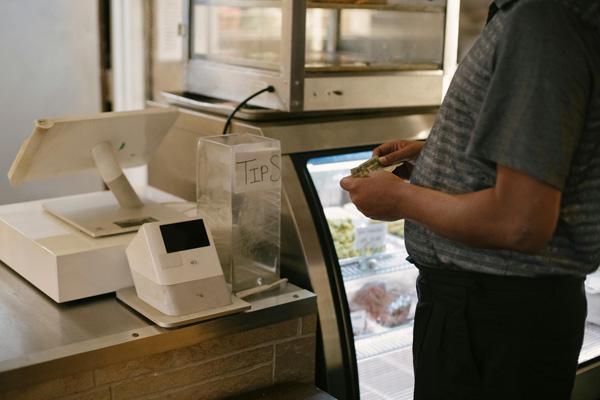
[An image of a customer tipping money. Photo Credit: Pexels]
In the past, tipping was a way of expressing gratitude for great service.
Today, however, many customers in the United States feel pressured to tip before they have even received personal service.
According to a 2026 Popmenu survey, 59% of consumers reported feeling compelled to leave a tip when a digital screen asks for one.
A customer could walk into a café or order bread from a bakery online, and then be met with a tipping screen asking for a 10% or 20% tip.
The food has not even arrived, yet they are already being pressured to pay for a reward that has not been earned yet.
This does not mean that all tipping should disappear.
Tipping can still be a meaningful way to express gratitude to workers for attentive personal service.
The real problem is that workers should not have to rely on customer tips as part of their basic wages, and businesses should not ask for tips in situations where little or no personal service is provided.
This form of tipping pressure is a growing national trend in the U.S.
A 2023 Pew Research Center survey found that 72% of U.S. adults felt that tipping was expected in more places than it had been five years earlier.
Guilt-tipping is behind many uncomfortable restaurant experiences, making people pay extra before they even get the chance to sit down.
Under federal law, some tipped employees can be paid as little as $2.13 per hour in direct wages, as long as their tips bring them up to at least the federal minimum wage.
When employees rely heavily on tips to meet minimum wage requirements, customers may feel as if they are being asked to help pay the worker’s salary directly.
Customers are also impacted by this system.
In 2023, DoorDash warned customers that deliveries may take longer without tips.
DoorDash claimed the issue was that Dashers, who are independent contractors, can choose which orders to accept, so orders without tips may be accepted more slowly.
Tipping has gone a long way from its traditional purpose, as it is now more of an expectation rather than a reward.
Employees are also put in a tough spot.
Constantly relying on tips means their paycheck is often insufficient and inconsistent.
At the end of the day, they need to rely on customers to make a living.
Not knowing how much money they will earn each week can make it harder for them to budget and make future plans.
A predictable wage would provide employees more stability and would also make prices clearer for customers.
To be fair, there are reasonable arguments in favor of tipping, but they do not solve the deeper problem.
However, these arguments do not address the deeper problem.
Tipping was meant for recognizing real service, not for adding pressure to every purchase.
When every restaurant, café, delivery app, or checkout screen business asks for a tip, the practice begins to lose its meaning.
It becomes a burden for customers and a source of stress for workers.
It stops being a simple act of gratitude and becomes an additional expected expense.
Both customers and employees are negatively affected as a result.
All things considered, stable incomes should be the top priority, not reliance on customer tips.
The tip-heavy culture in the United States has become an unsustainable method of payment when it replaces fair wages or appears in situations where little service has been provided.
Ending workers’ dependence on tips would not have to end gratitude.
Customers could still tip for exceptional service, but employees would no longer have to rely on inconsistent tips to earn fair wages, and consumers would finally be able to pay clearer and more transparent prices.

- William Kim / Grade 10 Session 13
- Sunny Hills High School